

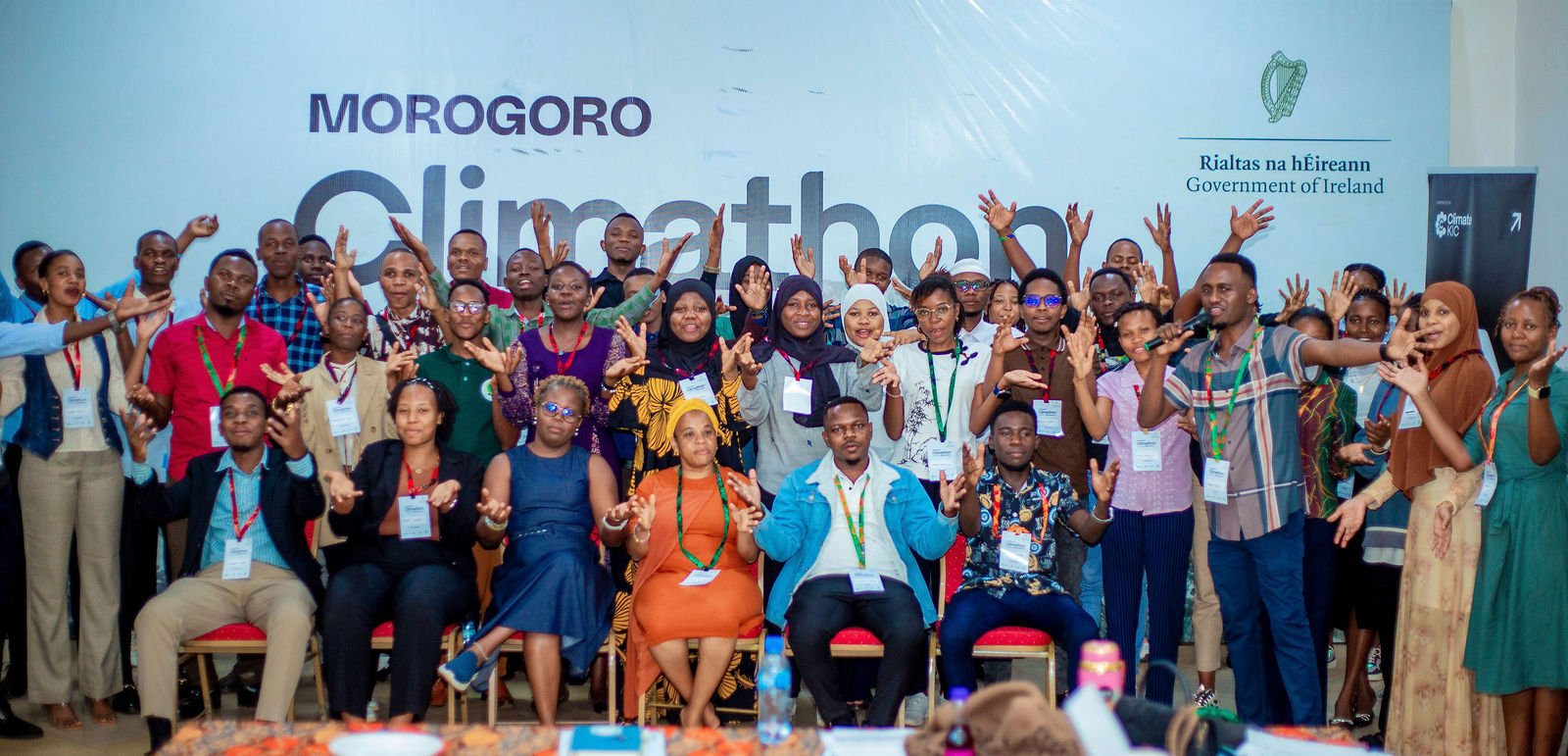
Climathon Morogoro: From Classroom to Climate Startup
When 50 university students walked into the Tushikamane Center on Kilakala Road for the first weekend of July, they came with different majors, different universities, and different ideas about what a climate solution should look like. Forty-eight hours later, they walked out with nine working business models — and one of them, a citrus-waste startup called PectSolutions, walked out with first place.
Climathon Morogoro 2026 was a two-day climate hackathon co-organized by the Kilimo Smart Initiative (KSI) and the EmpowerHer Tomorrow Initiative (EHTI), held on Friday, July 3rd and Saturday, July 4th, 2026, with support from Climate-KIC and Irish Aid.
Why Morogoro, Why Now
Morogoro is often called Tanzania’s agricultural “food basket” — more than 70% of the region depends directly on farming. But that identity is under strain. Rainy seasons that used to be predictable now arrive up to 30 days off schedule, and dry spells have grown more frequent, driving post-harvest losses as high as 30–40%. At the same time, rapid urbanization is generating 250–300 tons of solid waste every day, and less than half of it is being collected.
Those two pressures became the hackathon’s two challenge tracks:
- Topic 1: Climate-Smart Agriculture, Food Security & Agritech
- Topic 2: Circular Economy & Urban Waste Innovation
The challenges weren’t drawn up in isolation. KSI and EHTI worked directly with Morogoro’s Municipal Environmental Officer and academic experts from Mzumbe University to make sure the problems students were tackling reflected real regulatory and on-the-ground realities, not textbook abstractions.
Getting the Right People in the Room
Before a single team was formed, KSI and EHTI ran outreach campaigns across four local universities — Sokoine University of Agriculture (SUA), Mzumbe University, Jordan University College (JUCO), and the Muslim University of Morogoro (MUM). Posters on campus notice boards, newsletters, direct emails to over 500 students, radio press releases, and WhatsApp groups for environmental clubs all fed into one funnel.
The response was bigger than anyone expected: 266 applications for 50 spots. Finalists were selected and matched into balanced interdisciplinary teams using what organizers called the “Dream Team” formula — mixing science, business, and community development skills into each group.
The result was a cohort that hit a target few STEM programs manage: 54% women among participants (27 of 50), against an original goal of 60%.
Two Days, Nine Startups
Day One opened with expert briefings on agritech and circular waste challenges, followed by structured sessions on climate causality mapping and problem framing — the scaffolding teams needed before they could start designing solutions.
Day Two moved fast: a talk from a young green-startup founder on scaling ecological enterprises, a mentored deep-dive to build out full Business Model Canvases, and then, in the afternoon, Demo Day. Each team had five minutes to pitch and five more to field questions from a jury panel drawn from local NGOs and private-sector experts.
Nine ideas made it to the stage:
| Rank | Business | What it does |
|---|---|---|
| 1 | PectSolutions | Upcycles citrus waste into high-purity pectin for food and pharma industries |
| 2 | Old To Gold | Turns denim and textile waste into fashion accessories |
| 3 | Eco-Brick Tz | Converts plastic waste into building slabs and bricks |
| 4 | EcoThamani | Mobile-money-powered plastic collection hubs |
| 5 | Nuhydrop | Greywater recycling for urban households |
| 6 | GeoCycle AI | AI-optimized waste collection routing |
| 7 | Waste To Wealth | Composts market waste into organic fertilizer |
| 8 | SunSmart Agritech | Solar-powered smart drip irrigation |
| 9 | Mkulima Smart | Solar dehydration and USSD crop advisories |
PectSolutions, Old To Gold, and Eco-Brick Tz — the top three — didn’t just take home certificates and seed funding. They were admitted into the Climathon Morogoro Incubation Pathway: three months of free coworking space, rotational business and financial coaching, and direct mentorship to help turn prototypes into operating companies.
In Their Own Words
Julius Nasongelya, a student at SUA whose team built PectSolutions, described the shift the hackathon pushed him through — from studying environmental problems in a classroom to actually building something to solve one.
Costantine Edward, KSI’s co-lead and a jury member, said the cohort proved that the next generation of Tanzanian entrepreneurs can build businesses that are both economically viable and climate-resilient.
Veronica David Bey, CEO of EHTI, pointed to something less quantifiable than the pitch scores: watching young women lead the technical and strategic design work across so many of the teams.
What Made It Work
A few decisions ended up mattering more than expected. Shifting the Day 2 slide-deck deadline to 2:00 PM gave teams breathing room to rehearse before presenting — a small scheduling fix that resolved a real bottleneck. Bringing in the municipal waste and agriculture officers early meant teams weren’t designing in a vacuum; their solutions had to work within actual licensing and regulatory constraints from day one. And the interdisciplinary team matching — pairing science backgrounds with business and community development skills — turned out to be the difference between a good idea and a pitch-ready business model.
Made Possible By: Our Sponsors and Partners
None of this happens without the organizations that backed it financially and logistically:
- Climate-KIC provided the core funding — a €3,000 Climathon local grant delivered through its Youth Climate NGOs Programme — along with organizing toolkits, marketing branding guidelines, and reporting support that shaped the entire event lifecycle.
- Tushikamane Center hosted the event
- Kilimo Smart Initiative (KSI) & EmpowerHer Tomorrow Initiative (EHTI), the two co-organizing NGOs, donated an estimated €800 in-kind through mentorship and post-event incubation coaching for the winning teams.
- Ufaulu Project Tanzania supported university relations and student outreach across the four participating campuses.
- JustGreen Tanzania handled logistics, catering, and waste management support throughout the two days.
- The Morogoro Municipal Council lent institutional weight and real-world grounding, with its Municipal Environmental Officer serving as both a Day 1 challenge expert and a Day 2 jury member.
Together, this network of funders and partners turned a €3,000 grant into a two-day event that fed, housed, and mentored 50 students, launched nine startups, and set three of them on a three-month path toward becoming operating businesses.
The Numbers Behind the Event
The whole event ran on a €3,000 grant from Climate-KIC, supplemented by in-kind venue support from the Tushikamane Center and mentorship hours donated by KSI and EHTI. Roughly two-thirds of the cash budget went to venue logistics and catering for 60 people across two days, with the rest split between materials, outreach, facilitator support, and seed prizes for the winning teams.
Looking Ahead
With 3 startups now inside a formal incubation pathway and a proof of concept for what interdisciplinary, locally-grounded hackathons can produce, KSI and EHTI have a template they can likely take to other Tanzanian university towns facing the same climate pressures Morogoro does. For 50 students who spent a weekend turning frustration with dry spells and overflowing landfills into working business plans, that template started with a simple bet: give young people the right problem, the right teammates, and 48 hours, and see what they build.
All Categories
Recent Posts



info@empowerher.co.tz